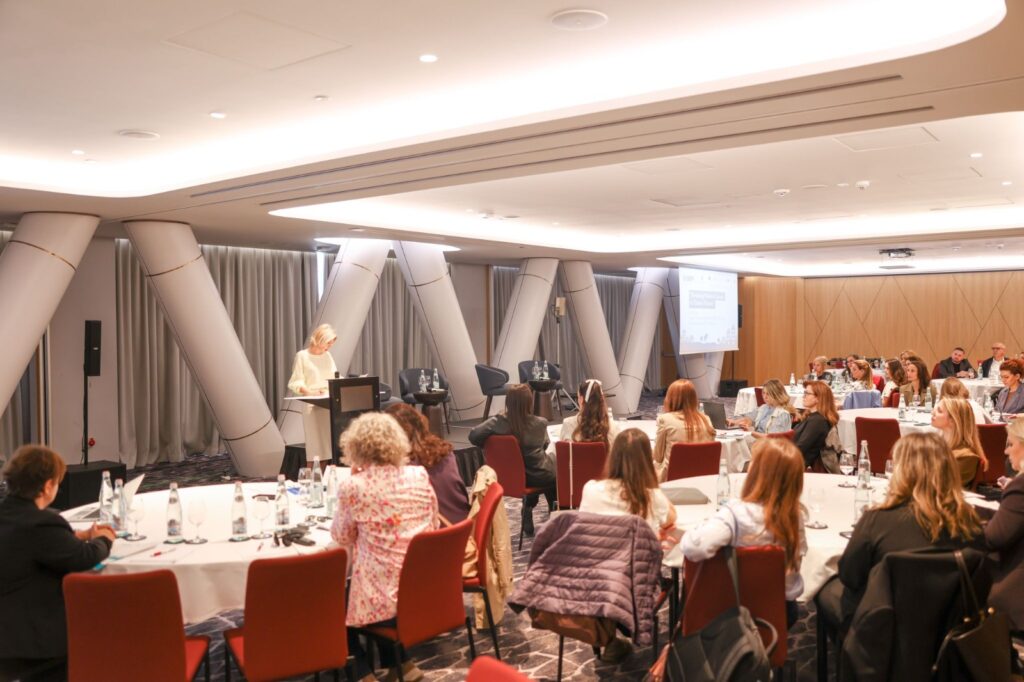

On May 5th, 2026, the Jean Monnet Module project participated in the national workshop “Promoting Women’s Access to Climate Finance”, organized under the Western Balkans Green Economy Financing Facility (GEFF III) Programme and hosted by the European Bank for Reconstruction and Development (EBRD) in Tirana.
The workshop brought together representatives from international organizations, policymakers, financial institutions, academia, and civil society to discuss the challenges and opportunities women face in accessing green finance and to explore ways for advancing gender equality within climate action initiatives.
During the event, the Jean Monnet Module leaders participated in the discussions and exchanges of views, contributing academic perspectives on the links between climate change, climate migration, climate justice, human rights, disaster risk management, and European Union policies. The discussions highlighted the importance of education and research in addressing the social dimensions of climate change and supporting evidence-based policymaking.
The participation of the Jean Monnet Module team emphasized the vital role of higher education institutions in fostering awareness, critical thinking, and informed debate on contemporary environmental and social challenges. Particular attention was given to the contribution of academia in strengthening understanding of climate-induced migration, climate justice, and the European Union’s policy responses to climate-related challenges.
As a dissemination activity, the workshop provided an important opportunity to engage with stakeholders working at the intersection of climate action, sustainable finance, gender equality, and public policy. The event further strengthened collaboration between academia, policymakers, and practitioners, highlighting the value of interdisciplinary dialogue in addressing complex environmental and social issues.
Through participation in national and international forums, the Jean Monnet Module continues to promote knowledge exchange, policy dialogue, and academic excellence while contributing to discussions on climate migration, sustainability, human rights, and European Union policies.